Speaking
AI works through the night. Someone still has to answer for what it decides.
You manage legal, tax and audit without understanding every detail, because you know what to ask and you can spot a poor answer. I offer two talks for boards, leadership teams and owners that point the same skill at AI.

The one-hour board briefing
- One hour, for the board or its risk committee. The four answers a team gives about AI, who is accountable, and what to ask next.
- About twelve slides. Each one carries a real case and a question a board member asks.
- No technical knowledge needed. The hour is about what to ask and how to judge the answer.
- Pages to keep. The questions, each with what a good answer sounds like and what should worry you.

The half-day session
- Three hours, four parts. Why the usual oversight misses AI, the four answers, who is accountable, and what to ask on Monday.
- For boards, leadership teams and owners. Up to 25 people, so everyone can speak about their own business.
- You write as we go. Each part ends with a few minutes on your own business, and nothing you write is collected.
- What you leave with. A map of where AI already works in your business, the names behind it and your questions for Monday.
I use plain words, and every point comes with a real case or a question you can ask on Monday.
What a session covers
The four answers a team gives, and what each one leaves out
“We are not really using AI yet.”
Your people already use it, often on their own accounts, and your software suppliers have switched it on inside products you pay for.
AskCould a list of every place we use AI, with an owner beside each one, be on my desk by Friday?
“We have a policy.”
A policy describes what should happen. In my own company an invented regulation is the failure I cannot afford, so the AI that reads regulation for me has no web search tool at all.
AskIf the AI breaks this rule at three in the morning, what stops it?
“The vendor takes care of that.”
You can hand over the work, and the accountability stays with you. In 2024 Air Canada argued it was not liable for what its website chatbot told a customer. The tribunal called that “a remarkable submission” and ordered the airline to pay.
AskWhat does the supplier’s AI do with our data, where does the contract say so, and when did we last check it ourselves?
“Don’t worry, a human reviews everything.”
An AI tool drafts 2,000 customer replies a day and one person reviews them all. In seven working hours that leaves under 13 seconds a reply, with no breaks.
AskLast month, how often did the reviewer say no? If the answer is never, someone is signing.
Who answers when the decider was not a person
Someone always answers: a regulator, a court or a client will look for a name, and the only choice is whether you picked it in advance. At Northern Trust the UK regulator approved me by name for the area I answered for, and I learned that the defence is what you wrote down at the time. Before any AI starts work, a board needs three decisions and one name.
- On its ownWhat the AI may do without askingDrafting, sorting, summarising: things that are cheap to get wrong.
- After a yesWhat it may do only after a person says yesSending to a client, paying, changing a customer’s record.
- NeverWhat it must never doBlocked by the system itself: no permission, no key, a locked gate.
- One nameThe person who owns it and can switch it offSomeone who would take the regulator’s call.
- In writing“Our customer service assistant does not issue a refund above AED 2,000 without approval from the Head of Customer Service.”A limit has three parts: an action, a size and a person.
What to ask on Monday morning
These are three of the session’s eight questions. Each person picks their own three and the person they will ask.
- The list
- Where are we using AI today, including the tools staff use and the AI inside software we already pay for?A good answer is one list with an owner against each use, updated this quarter.
- The stop
- How do we stop it, how fast, and when did we last try?A good answer has a named person, a time in minutes and the date of the last test.
- The money
- Which AI projects are worth the money, once we count what failure would cost?A good answer puts the value and the downside of each side by side, in numbers.
And the one question to keep: if our AI made a serious mistake at three o’clock tonight, who would know, who could stop it, and who would answer for it?
The book
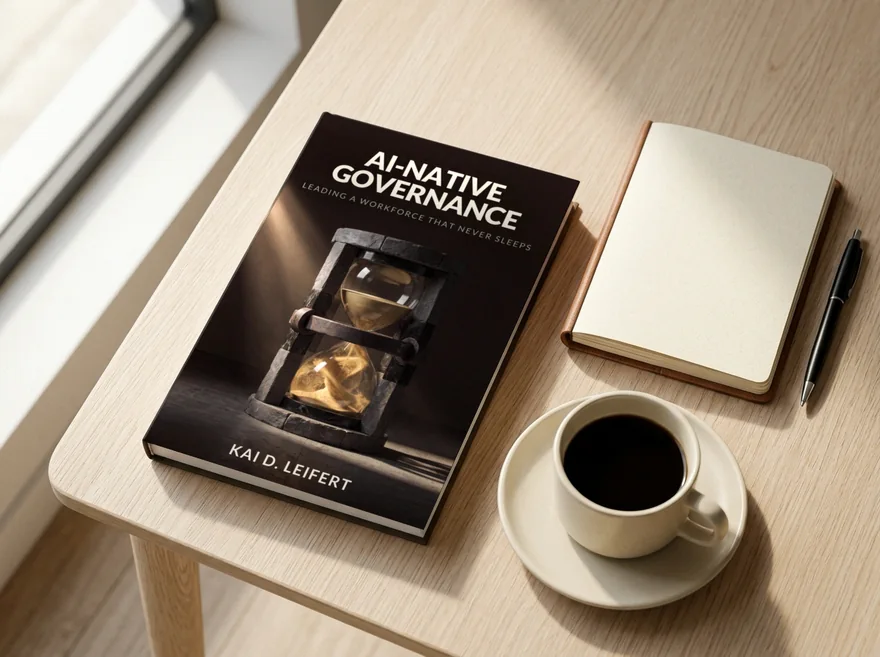
AI-Native Governance: Leading a Workforce That Never Sleeps
Both talks come from my book, out on 11 December 2026. It treats AI as a workforce to lead with written orders, limits and records, and it sets out seven things to build, from a list of every AI system you run to a published list of what yours cannot do. For a board, the one-hour briefing and ten copies of the book come together as one piece of work.

Tell me who will be in the room and how much time you have.